How Flareway works: Cloudflare Tunnel and Envoy
Each Gateway becomes a Cloudflare Tunnel that dials out, so the cluster needs no inbound ports or public IPs, and an in-pod Envoy runs the HTTPRoute rules.
One Gateway, one tunnel, one data plane
Section titled “One Gateway, one tunnel, one data plane”A Gateway names its CloudflareTunnel through the standard
spec.infrastructure.parametersRef, with no annotations:
apiVersion: gateway.networking.k8s.io/v1kind: Gatewaymetadata: name: public namespace: defaultspec: gatewayClassName: flareway infrastructure: parametersRef: group: flareway.bhyoo.com kind: CloudflareTunnel name: publicFlareway then runs one data-plane Deployment for that Gateway. Each pod holds
cloudflared and Envoy, plus a CoreDNS sidecar when the Gateway has private
listeners:
cloudflaredopens outbound QUIC or HTTP/2 connections to Cloudflare’s edge.- Envoy receives decrypted requests from
cloudflaredover loopback and applies the routing rules the controller streams to it. - The CoreDNS sidecar answers private hostnames with
127.0.0.1, so WARP traffic also passes through Envoy.

Public hostnames reach the tunnel through the Cloudflare edge, and WARP devices reach it through a private network route. Nothing on the cluster side listens for inbound traffic from the internet.
The same system in Kubernetes-object terms shows the node, the controller pod, and the data-plane pod’s containers:
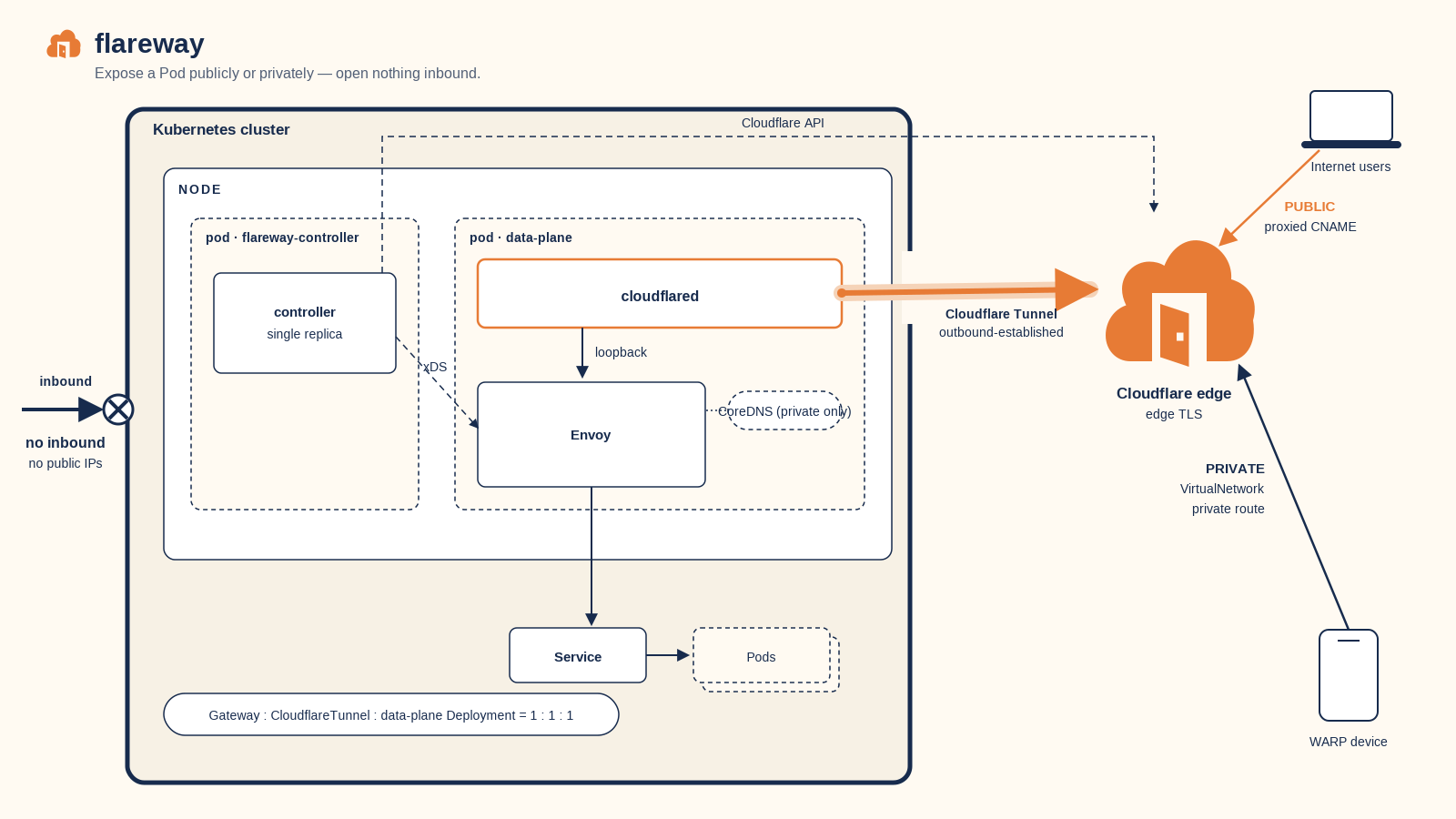
Transport and routing
Section titled “Transport and routing”cloudflared carries transport only. Flareway writes its ingress rules so that
each public hostname forwards to a loopback Envoy port, one port per hostname
or Access protection domain. A hostname that must stay blocked gets a
http_status:403 rule instead.
Envoy does the routing. The controller compiles HTTPRoute rules into Envoy
listeners and route tables and streams them over xDS (Delta ADS). Matching,
rewrites, redirects, mirrors, timeouts, and weighted splits therefore run in
Envoy, beyond what cloudflared ingress rules can express.
HTTP routing lists what is supported.
The data plane runs the upstream cloudflared and Envoy images; a Gateway with
private listeners also runs a CoreDNS sidecar. The chart defaults pin each image
by digest. Flareway does not fork them.
Public and private listeners
Section titled “Public and private listeners”On a public listener, Cloudflare owns edge TLS. Flareway creates a proxied CNAME record that points to the tunnel hostname and marks its ownership in the record comment. A public listener that references its own certificates is rejected.
A private listener works the other way. Envoy terminates TLS, so the listener
must use HTTPS and name a certificateRefs Secret you supply, for example
from cert-manager or an internal CA. Flareway does not issue certificates. The
matching CloudflareTunnel.spec.listeners[] entry sets exposure: Private,
and a HostnameRoute or NetworkRoute sends WARP traffic to the tunnel.
Whether the Cloudflare edge accepts the 127.0.0.1 answer for a private
hostname has not been verified live; see Limits.
Access on routes
Section titled “Access on routes”When an AccessApplication targets a listener or route, Flareway creates the
Cloudflare Access application and policy at the edge and verifies the Access
JWT again at the origin: cloudflared and Envoy check it for public
hostnames, and Envoy checks it for private ones.
Security model covers the defaults, the blocked state
before the AUD tag is known, and what happens when a policy is deleted.
Gateway mode and Direct mode
Section titled “Gateway mode and Direct mode”Every tunnel has exactly one writer for its remote configuration.
CloudflareTunnel.spec.configuration.mode defaults to Gateway, where the
Gateway controller owns the whole configuration. Gateway ownership is bound to
the Gateway’s UID: a second Gateway cannot take over the tunnel until the
current owner is removed and its connector Pods drain.
Direct mode hands the whole configuration to you. You write the ingress
rules under configuration.direct.ingress, and each rule selects one service
type such as http, tcp, ssh, rdp, or bastion. Use it for origins
that are not behind a Gateway; see Direct tunnels.
The object map
Section titled “The object map”Standard Gateway API objects and Flareway resources reference each other like this:
GatewayClass→GatewayClassConfig(spec.parametersRef), which names aCloudflareAccount(spec.accountRef).Gateway→CloudflareTunnel(spec.infrastructure.parametersRef), which names aCloudflareAccount(spec.accountRef).HTTPRoute→Gateway(spec.parentRefs).AccessApplication→ aGatewaylistener or anHTTPRoute(spec.targetRefs).
Flareway’s own resources are in the flareway.bhyoo.com/v1alpha1 API group:
| Area | Resources |
|---|---|
| Gateway and account | GatewayClassConfig, CloudflareAccount, CloudflareTunnel |
| Access | AccessApplication, AccessStandaloneApplication, AccessPolicy, AccessGroup, IdentityProvider, AccessCustomPage, DevicePostureRule, DevicePostureIntegration, AccessInfrastructureTarget, ServiceToken |
| Private network | VirtualNetwork, NetworkRoute, HostnameRoute, WARPConnector |
| Account-wide settings | DeviceProfile, DeviceSettings, ZeroTrustOrganization, ZeroTrustGatewayPolicy, ZeroTrustList |
The API reference documents every field.
Architecture decisions
Section titled “Architecture decisions”The architecture decision records explain why Flareway is built this way. Start with ADR 0001: Gateway API on Cloudflare Tunnel for the overall model; the tunnel status contract is in ADR 0004: One field manager for tunnel conditions.